Time Management for Leaders: From Busy to Strategic
Mar 16, 2026Let me ask you a quick question.
If someone looked at your calendar this week, would they see a strategic leader or a very
reliable executor?
For many women in leadership roles, this question lands a little too close to home.
You’re capable. You prepare thoroughly. You keep projects moving and make sure nothing falls
through the cracks. On paper, you’re doing everything right.
And yet something frustrating happens.
When strategic opportunities or promotions come up, you may notice that you’re still seen as the
person who gets things done, not the person who sets direction.
This is exactly where time management for leaders becomes more important than most people
realize.
Leadership is not just about how much you accomplish. It’s about what your time signals about
your priorities, your thinking, and the level at which you operate.
Your calendar quietly tells the organization how to perceive you.
Hi, I’m Liz Mayer. I work with high-achieving women in corporate roles who want to grow their
influence, impact, and income without burning out.
One of the biggest shifts we make together is redefining time management for leaders, because
your calendar doesn’t just organize your day. It shapes how others see your leadership.
In this article, we’ll explore how your schedule may unintentionally be signaling execution
instead of leadership—and what small shifts can move you from busy to strategic.
Time Management for Leaders Starts With Your Calendar
One of the most overlooked truths about leadership is that your calendar tells a story before you
even open your mouth in a meeting.
At senior levels of an organization, leaders are not evaluated by how many tasks they personally
complete. They are evaluated by how they spend their time and where they focus their attention.
That’s why time management for leaders starts with the calendar.
Your schedule reveals what you prioritize, how you think about the business, and the level at
which you’re operating.
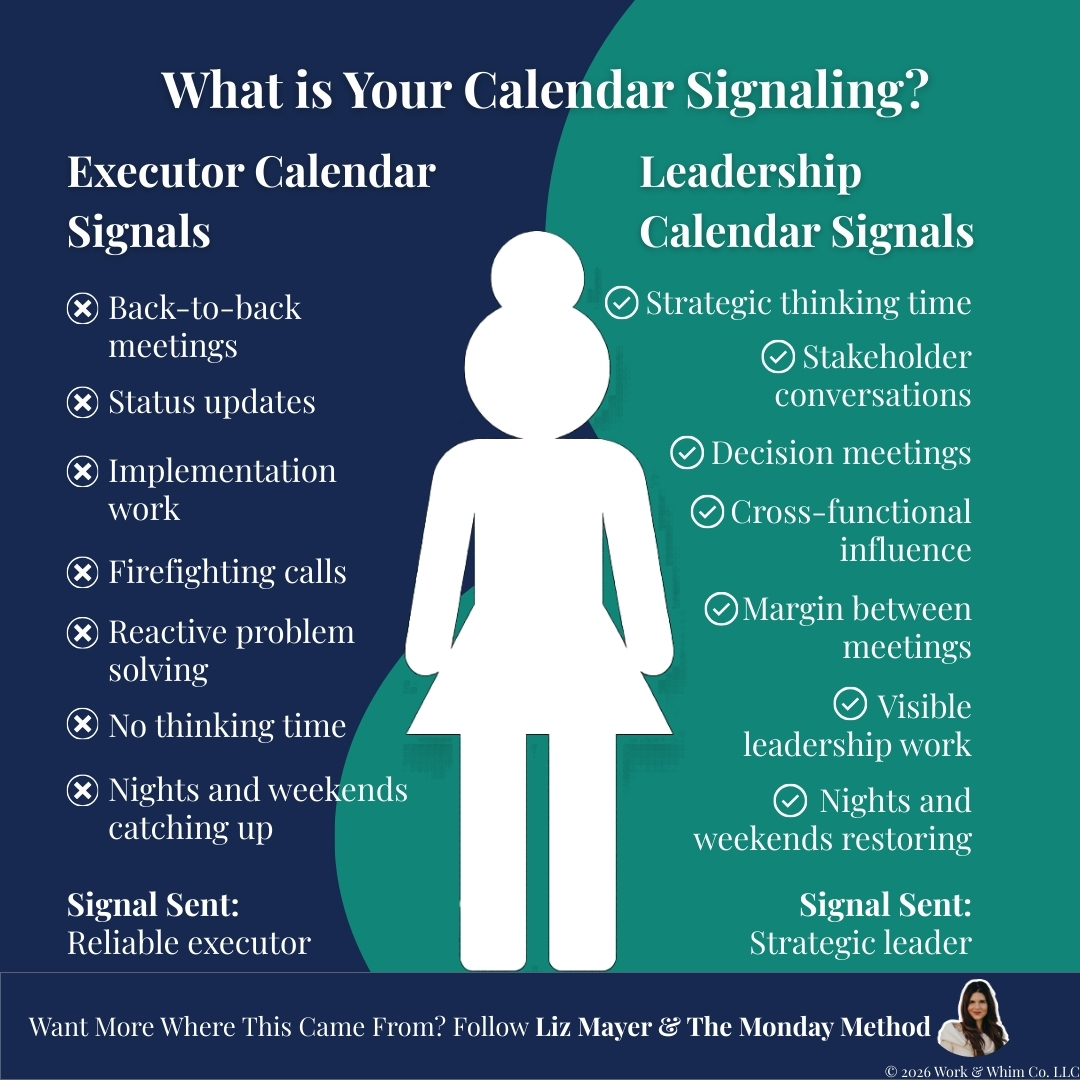
A calendar filled with operational meetings communicates execution.
A calendar intentionally structured around thinking time, strategic conversations, and key
stakeholders communicates leadership.
Many high-achieving women unintentionally signal “reliable executor” simply because their
schedules are packed with responsibilities that keep the business running.
They’re in every meeting. They’re solving every issue. They’re supporting everyone around
them.
Those behaviors come from dedication, not weakness.
But the shift from busy to strategic leadership begins with recognizing that your calendar isn’t
just a planning tool. It’s a leadership signal.
What Most Calendars Look Like
When many women leaders look honestly at their calendars, a pattern usually emerges.
The schedule is completely full, yet it rarely reflects leadership priorities.
This is one of the most common challenges in time management for leaders, particularly for
women who built their careers on being capable, responsive, and dependable.
Most calendars are packed with back-to-back meetings.
Status updates dominate the day. Conversations revolve around reporting progress instead of
shaping decisions. There’s little time to prepare, reflect, or reset between discussions.
The day becomes a constant stream of commitments requiring immediate attention.
Operational issues also tend to take over the schedule. Leaders step in to solve problems,
unblock teams, and keep projects moving forward. Over time, this creates a pattern of
firefighting where the leader becomes the person who fixes things whenever something breaks.
Strategic thinking rarely happens inside that environment.
Instead, the real leadership work gets pushed to nights or weekends. Planning the future happens
whenever a small pocket of time appears between urgent requests.
This pattern reflects dedication. Most women leaders care deeply about their teams and want to
ensure nothing slips through the cracks.
However, without intentional time management for leaders, reliability can unintentionally
signal that your primary value is execution rather than leadership.
And when your calendar is dominated by operational work, the organization naturally sees you
as someone who belongs in the execution layer of the business—not the person shaping the
vision.
What Next-Level Leaders’ Calendars Look Like
Strategic leaders approach their schedules differently.
They still support their teams and attend meetings, but their time reflects influence, priorities,
and direction.
This is where time management for leaders begins to shift from managing activity to shaping
outcomes.
One noticeable difference is protected thinking time.
Strategic leaders understand that strong decisions require space. They schedule time to review
priorities, evaluate opportunities, and connect daily work to broader business goals.
Another difference is how they invest time in relationships.
Instead of filling every hour with internal status meetings, they intentionally spend time with
stakeholders and decision-makers across the organization. These conversations help shape
strategy and expand influence.
Strategic calendars also contain margin.
There is space between meetings to prepare, reflect, and remain present. This breathing room
allows leaders to think clearly instead of rushing from conversation to conversation.
Effective time management for leaders is not about filling every hour.
It’s about structuring time in a way that supports clear thinking, strong relationships, and
confident leadership decisions.
When a leader’s calendar reflects these priorities, people begin to see them not just as the person
executing the work—but as the person leading it.
Why Time Management for Women Leaders Is Not About Doing More
Many ambitious women assume improving their schedule means becoming more efficient.
The typical advice around time management for leaders focuses on productivity hacks, better
to-do lists, or squeezing more output into an already full day.
In reality, leadership operates under a completely different set of rules.
At higher levels of responsibility, success is not determined by how many tasks you complete. It
is determined by the impact of your decisions and the influence you create.
Hustle culture in corporate environments often convinces high performers that the path to
advancement is working harder and proving reliability through constant output.
Over time, that mindset leads to exhaustion and limits visibility as a strategic leader.
Effective time management for women leaders is not about doing more work.
It is about focusing on the work that signals leadership capacity and creates leverage.
The Workhorse Trap Many Women Fall Into
Many women rise in their careers because they are exceptionally capable.
They deliver results consistently. They take responsibility when things get complicated. They
become the person others trust.
These strengths build credibility early in a career.
However, they can also create what I call the workhorse trap.
In this pattern, the leader becomes the reliable executor.
When deadlines are tight, they step in. When problems appear, they fix them. When a team
member feels overwhelmed, they absorb the extra work.
Their reputation becomes tied to dependability and execution.
While these strengths are valuable, they can quietly limit growth at higher levels.
Without intentional time management for leaders, high performers become known as the
person who always gets things done. That identity makes it harder for others to imagine them
operating at a strategic level.
The workhorse trap often includes staying involved in operational details, taking ownership of
tasks that could be delegated, and shielding the team from pressure by solving problems
personally.
Over time, the leader remains embedded in execution rather than shaping direction.
Promotions rarely follow that pattern.
Senior roles require leaders who focus on strategy, decision-making, and alignment across teams.
Why Hard Work Alone Doesn’t Lead to Promotion
Early in a career, strong performance often leads to recognition.
Hard work produces results, and results create opportunities.
But at more senior levels, the equation changes.
Promotions are rarely based on effort alone. Decision-makers look for individuals who
demonstrate strategic thinking, sound judgment, and the ability to influence outcomes across the
organization.
This is where time management for leaders becomes directly connected to career advancement.
Strategic thinking requires space.
Leaders need time to evaluate opportunities, identify patterns, and anticipate future challenges.
Decision-making visibility is another factor.
Leaders who participate in strategic conversations gain exposure with senior stakeholders and
shape the direction of key initiatives.
Influence also matters.
Leaders who invest time building relationships across teams create trust and alignment. Those
connections often determine who is invited into critical conversations.
Without intentional time management for leaders, energy goes toward maintaining current
responsibilities rather than expanding influence.
The leaders who advance most consistently are not the ones completing the most tasks.
They are the ones allocating their time toward strategy, relationships, and decisions.
Three Time Management Shifts Leaders Must Make
Once leaders recognize that their calendar signals how they operate, the next step is redesigning
how that time is used.
Strategic leaders do not simply work faster or pack more tasks into the day.
They allocate time intentionally toward thinking, influencing, and sustaining their energy.
These shifts may look small, but they dramatically change how others perceive your leadership.
Shift 1 – Schedule Strategic Thinking Time
The first shift in time management for leaders is creating dedicated thinking time each week.
Strategic decisions rarely happen in the middle of a packed schedule.
Blocking time to review priorities, assess progress, and evaluate opportunities allows leaders to
step out of reactive mode.
Treating thinking time as a leadership responsibility—not a luxury—ensures strategic priorities
remain visible.
Shift 2 – Protect Stakeholder Time
Leadership happens through relationships.
Protecting time for stakeholder conversations expands influence across the organization.
These conversations are not status updates. They are opportunities to align priorities, shape
decisions, and build trust with key partners.
Strong relationships often determine whose ideas move forward.
Shift 3 – Build Recovery Margin
The final shift in time management for leaders is creating margin between commitments.
Back-to-back meetings drain energy and force reactive decisions.
Short pauses between conversations allow leaders to reset mentally, prepare for discussions, and
remain present.
Margin improves decision-making and protects energy throughout the day.
This is where tools like the FREE Energy ROI Map can be incredibly helpful, because they show you which parts of your schedule are draining your leadership capacity and which ones are actually creating influence.
Frequently Asked Questions
What is the 3-3-3 rule in time management?
The 3-3-3 rule suggests focusing on three hours of deep work, three medium-priority tasks, and
three smaller activities each day. While originally designed for productivity, leaders can use the
concept to ensure important strategic work happens before reactive tasks take over.
What are the 5 P’s of time management?
The 5 P’s stand for Proper Planning Prevents Poor Performance. In leadership, this principle
emphasizes thoughtful preparation so leaders can focus on strategic decisions rather than
constant firefighting.
How do you manage time as a leader?
Effective time management for leaders involves prioritizing strategy, stakeholder relationships,
and team leadership while delegating operational tasks that do not require direct leadership
involvement.
What is the 30-60-90 rule for leaders?
The 30-60-90 framework is often used when entering a new role. The first 30 days focus on
learning, the next 60 on contributing, and by 90 days leaders begin shaping strategy and
direction.
Conclusion
By now, one thing should be clear.
Time management for leaders is not about cramming more tasks into your day.
It’s about designing a calendar that reflects the level of leadership you’re ready to operate at.
When your schedule is filled with execution, the organization sees an executor.
When your calendar creates space for thinking, alignment, and influence, people begin to see a
strategic leader.
The shift from busy to strategic starts with awareness.
Your calendar is one of the clearest signals of how you lead.
Small changes—protecting thinking time, prioritizing stakeholder relationships, and creating
margin—can transform how your leadership shows up.
So here’s a final question:
If someone looked at your calendar this week, would they see a strategic leader—or a
dependable executor?
If this conversation resonated with you, I’d love to stay connected. You can connect with me on LinkedIn and follow The Monday Method page, where I regularly share insights on leadership, influence, and building a career that works for your whole life—not just your calendar.
Don't miss a beat!
New moves, motivation, and classes delivered to your inbox.
We hate SPAM. We will never sell your information, for any reason.
